
I. The First Circuit Court of the Supreme People’s Court
The First Circuit Court was established in Shenzhen on January 28, 2015, following the decision to establish circuit courts to hear major cross-regional administrative, civil and commercial cases. It moved to its current location at No. 6 Gongxin Street, Nanshan District, on April 3, 2023.
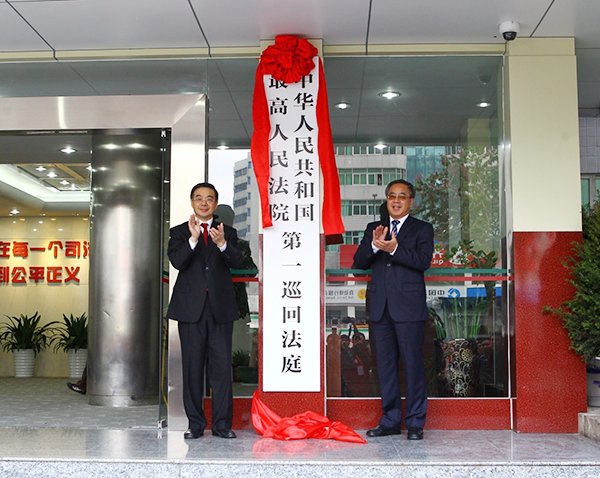
The First Circuit Court is a permanent adjudicatory body dispatched by the Supreme People’s Court. Its circuit covers Hunan, Guangdong, Guangxi and Hainan. It handles major first-instance administrative cases, influential first-instance civil and commercial cases, appeals and retrial applications involving high people’s courts, criminal petitions, Hong Kong–Macao–Taiwan civil and commercial cases, judicial-assistance matters and other cases designated by the Supreme People’s Court.
II. The Neutral Legal Service Station
The station was inaugurated on May 29, 2024, together with a symposium for volunteer litigation-service experts. It organizes volunteer experts to assist with the resolution of litigation-related petitions, litigation services and other public-interest work. The initiative applies the New Era “Fengqiao Experience”, strengthens grassroots legal-service stations and supports social governance.
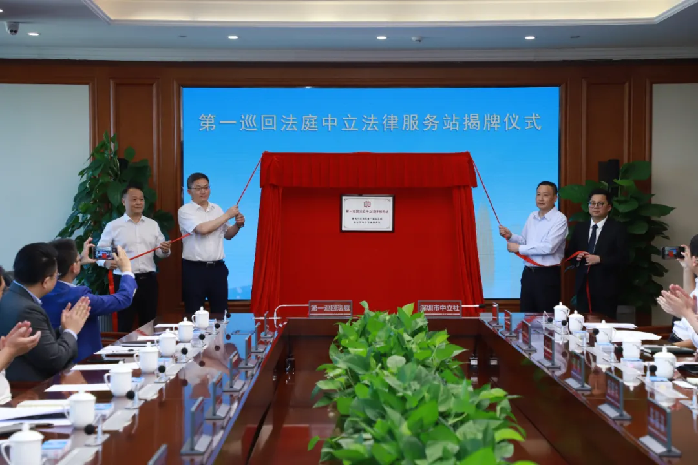
Establishing the station and organizing volunteer experts to help resolve litigation-related petitions and provide litigation services is an important way to develop the New Era “Fengqiao Experience”. It also gives practical support to grassroots legal-service stations and social governance. Hu Gengxiang, Executive Deputy Secretary of the Shenzhen Political and Legal Affairs Commission and Executive Vice President of the Shenzhen Law Society, expressed his appreciation to the first group of volunteer experts and emphasized the need for people-centered, professional and well-organized public-interest legal services.
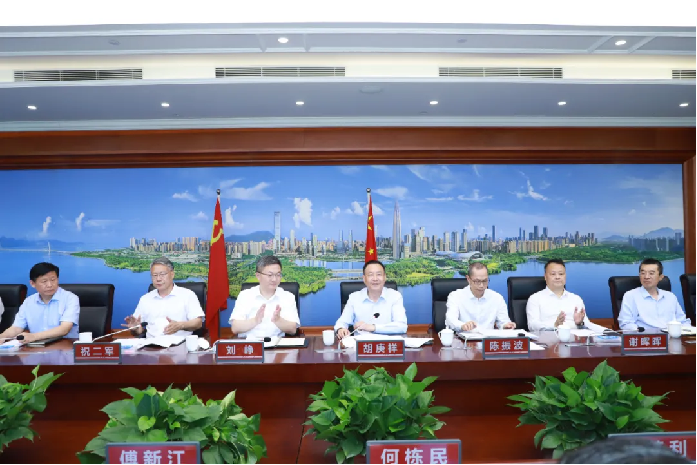
Liu Zheng, a member of the First Circuit Court Party Group and Deputy Presiding Judge, conveyed Vice President Yang Wanming’s appreciation for the support provided by Shenzhen. He said that the volunteer-expert window brings third-party resources into the substantive resolution of litigation-related petitions and strengthens coordination between the court and local authorities. The first group of 20 volunteer experts will provide on-site consultation, petition reception, dispute-resolution guidance, liaison and coordination, and public legal education.
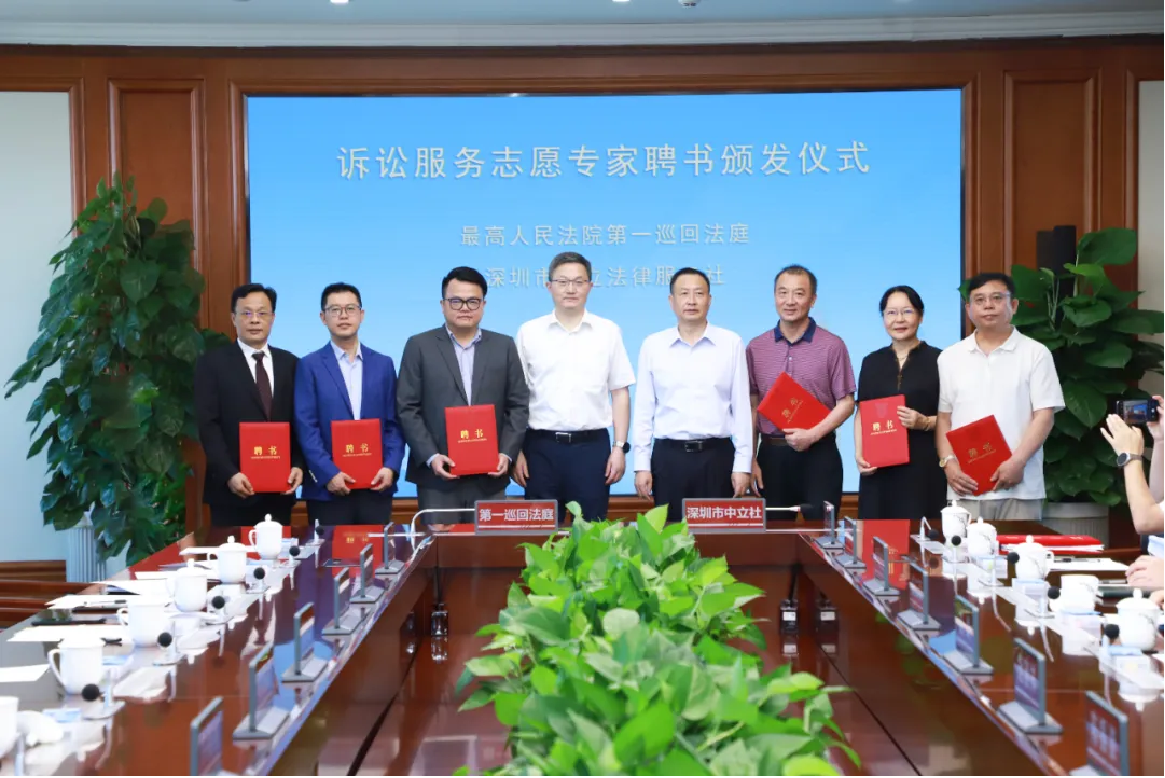
The ceremony was attended by representatives of the First Circuit Court, Shenzhen political and legal authorities, the Shenzhen Law Society, the Qianhai authority, judicial-administration departments, district law societies and Shenzhen Zhongli Legal Services Society. Together, they will continue to improve the station’s procedures and support diverse, efficient dispute resolution.
III. Service Team
Director: Chen Wenfeng, 13425132639, Guangdong Menghai Law Firm
Deputy Director: Deng Fengying, 18676707778, Hunan Furong (Shenzhen) Law Firm
Deputy Director: Li Xinyan, 13246734901, Zhong Lun Wende Hu Baiquan (Qianhai) Joint Law Firm
Deputy Director: Zhou Mi, 13602689000, Tahota (Shenzhen) Law Firm
Secretary-General: Wang Zhongkai, 17722803902, Guangdong Huashang Law Firm
Deputy Secretary-General: Deng Meng, 13923810341, Guangdong WeBank Law Firm
Full-time Liaison: Gao Han, 19042766755, Shenzhen Zhongli Legal Services Society
IV. Working Rules for Volunteer Experts
The volunteer experts shall follow the principles of objectivity, neutrality, rigor, professionalism and conscientious performance. They shall receive visitors patiently, use legal knowledge and litigation experience to provide consultation, and help resolve disputes.
- Provide litigation consultation and promote dispute resolution.
- Provide appropriate psychological guidance and help visitors accept lawful outcomes.
- Provide consultation and assistance to women and children involved in cases.
- Submit written observations on potentially problematic cases through the station’s procedures.
- Participate in cases referred by the First Circuit Court as arranged by the station.
- Join invited expert groups and issue expert opinions on doubtful cases.
- Attend case seminars and other meetings when invited.
- Perform other duties assigned to volunteer experts.
Experts shall wear the required identification, follow the unified management of the litigation-service hall, and shall not provide or arrange paid legal services for visitors. Case information obtained through visitors, parties or the station’s online platform must remain confidential. Experts may not use their volunteer status for online promotion or case solicitation, privately meet parties at the station, or make direct submissions to the First Circuit Court outside the station’s procedures.
The service scope generally covers matters legally accepted by the First Circuit Court. The station arranges duty rotations, invited consultations and expert groups. The consultation process includes understanding the facts, clarifying the visitor’s questions and requests, providing professional advice, and submitting recommendations for handling potentially problematic cases.
Cases are handled through graded management and according to their nature, including out-of-level petitions, civil and administrative retrial applications, civil and administrative petitions, criminal petitions, intellectual-property, maritime, foreign-related commercial, death-penalty review, state-compensation and enforcement matters. Where an answer cannot be given immediately, materials may be collected for further study. The station shall regularly summarize consultation and case-review statistics and report them to the First Circuit Court.
V. Code of Conduct for Volunteer Experts
- Do not make statements attacking the political or legal systems of the Party or the state, or insulting, defaming or threatening others.
- Address visitors appropriately and communicate calmly and fairly.
- Use proper legal terminology and explain it in accessible language where necessary.
- Avoid condescension, harsh language and rude conduct that may intensify disputes.
- Base legal analysis on facts and law and do not guarantee a litigation result.
- Do not solicit or accept property, money, securities, gifts or other benefits.
- Report relevant issues through the Society’s procedures rather than making a personal direct report.
- Follow the working rules and confidentiality requirements.
- Violations during duty will be handled by the Society according to applicable rules.
- This code takes effect on May 30, 2024, and is interpreted by Shenzhen Zhongli Legal Services Society.
VI. Review Rules for Doubtful Cases
- A doubtful case is a case in which an expert identifies a possible problem while receiving a visitor or providing legal consultation.
- The expert conducts a preliminary assessment of whether a problem exists and its nature and seriousness.
- If a problem appears to exist, the expert submits a written report and case materials to the station.
- The station organizes a comprehensive review of the facts, evidence, statements and preliminary assessment.
- For major cases or divergent opinions, the station may organize an expert discussion.
- The station prepares a written report based on the expert opinions and submits it through the Society to the First Circuit Court.
- The station follows the case progress and may provide the final result to participating experts.
- These rules take effect on May 30, 2024.
- These are internal rules and are not publicly disclosed; applicable legal provisions shall be read according to their latest amendments.